In-orbit inspection: why seeing a satellite up close matters
Radars and telescopes on the ground can say where an object is. A vehicle in orbit can show what it is, what state it is in, and what is happening around it.
In short
- About 40,000 objects are tracked in orbit, about 11,000 of them active satellites. ESA estimates that more than 1.2 million debris objects larger than 1 cm are not tracked.
- Ground surveillance gives orbits. In-orbit inspection gives close-range images and a view of an object’s condition and motion.
- Inspection relies on rendezvous and proximity operations, with collision avoidance as a core function.
- Operators, agencies preparing debris removal and defence organisations all need it, for different reasons.
A more crowded orbit
According to ESA’s Space Environment Report 2025, space surveillance networks track about 40,000 objects in Earth orbit, of which about 11,000 are active payloads. Statistical models estimate more than 1.2 million debris objects larger than 1 cm, each large enough to cause catastrophic damage, and over 50,000 larger than 10 cm.
The report also notes that, even without any new launch, the number of debris objects would keep growing, because fragmentations add objects faster than the atmosphere removes them.
What ground surveillance cannot see
Radars and optical telescopes measure positions and build catalogues of orbits. They can warn an operator that an object will pass close to its satellite. They rarely say what that object is, whether it is tumbling, or whether a nearby satellite has lost a panel.
Distance makes this harder in geostationary orbit. At 36,000 km, a satellite a few metres across is far too small for a ground telescope to resolve in detail through the atmosphere.
How in-orbit inspection works
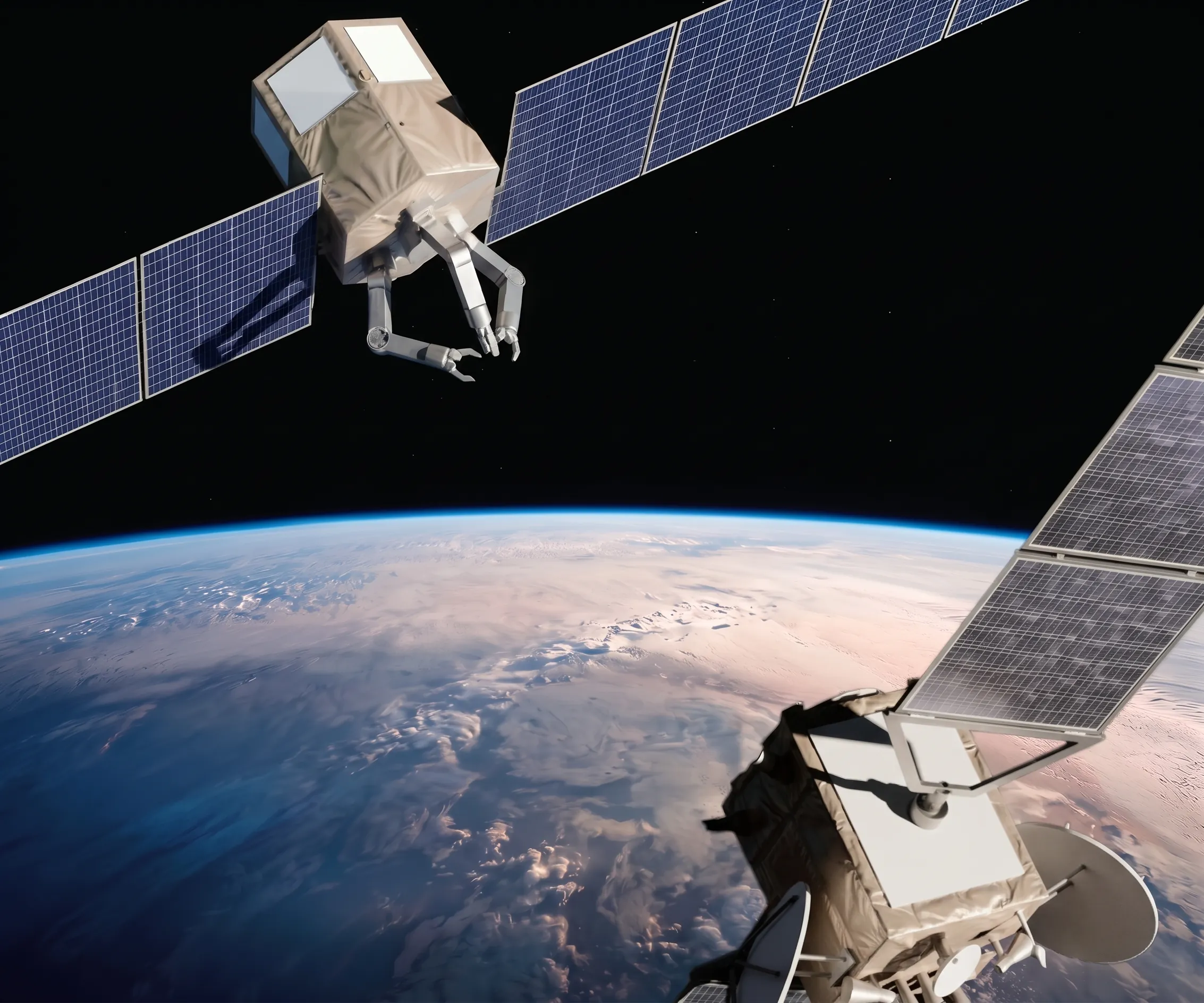
Inspection belongs to a family of manoeuvres called rendezvous and proximity operations. The inspecting vehicle first reaches the orbit of its target, then closes in by steps, holding positions at safe distances, flying around the object and taking images from several angles and under different lighting.
A recent mission shows the sequence. ADRAS-J, built by Astroscale for a JAXA programme, was launched in February 2024 to inspect the upper stage of a Japanese H-IIA rocket, in orbit since 2009. It held a position about 50 m from the stage, flew around it, and in November 2024 approached to about 15 m. During the final approach its onboard collision avoidance system triggered an autonomous abort, and the spacecraft moved away as designed.
Collision avoidance is therefore a core function of any inspection vehicle, which must be able to back away at any moment, including when the target behaves unexpectedly.
Who needs in-orbit inspection
Satellite operators
An operator facing an anomaly, such as a solar array that failed to deploy or a sudden loss of power, can get images of its own satellite to understand what happened and decide what to do next.
Agencies and debris removal
Before capturing a debris object, a servicer needs to know its shape, its condition and how it rotates. Inspection is the first phase of any removal mission.
Defence and security
In 2018 the French Minister for the Armed Forces stated publicly that a Russian satellite, Luch-Olymp, had come close to the Franco-Italian military communications satellite Athena-Fidus in 2017. France presented its space defence strategy the following year, with the surveillance of space and the protection of its satellites among its priorities.
Inspection with a vehicle that can travel
Thorus approaches objects within a safety perimeter and observes them visually. Its HPCR® electric propulsion lets it change orbit to reach a target, from low Earth orbit to geostationary orbit, and the same vehicle carries out orbit raising or life extension missions between two inspections.
Because the fleet serves both commercial and public users, a Thorus can already be in orbit when a public mission needs one, and be tasked at short notice to inspect a strategic asset. Thorus is designed in France with European partners, and minimising ITAR dependencies is a design criterion.
The TAC (Tactical-Capture) programme, funded by the European Defence Fund and coordinated by OSMOS X, develops a servicer able to approach an object in orbit, inspect it and attach to it without a docking interface. The programme page lists its seven partners.
Our serviceInspection and protection with ThorusClose-range observation of objects in orbit, for operators, agencies and defence.Frequently asked questions
What is space situational awareness?
Space situational awareness (SSA) is knowing which objects are in orbit, where they are and how they behave. It combines ground radars, telescopes and, increasingly, sensors in orbit.
How close can an inspection vehicle get to a satellite?
It depends on the mission and on the safety rules agreed with the operator of the target. In 2024 the ADRAS-J demonstration approached a rocket upper stage to about 15 m.
Can Thorus inspect satellites in geostationary orbit?
Thorus is designed to operate from low Earth orbit to geostationary orbit, and moves between orbits to reach the object it has to inspect.
Is inspection the same as debris removal?
No. Inspection observes an object without touching it. Removal requires capturing the object or acting on it, and is a future capability for Thorus.
Sources
- ESA, Space Environment Report 2025
- Astroscale, ADRAS-J achieves historic 15-meter approach to space debris, December 2024
- Astroscale, ADRAS-J demonstrates fly-around observations of space debris, 2024
- AFP via Phys.org, France to develop its space defence strategy, July 2019
- AFP via The Local, France says Russia tried to spy on satellite, September 2018