Satellite life extension: keeping working satellites in service
A geostationary satellite usually reaches the end of its life when its tanks run dry, while its payload still works. Life extension gives that satellite more years in service.
In short
- Station-keeping in GEO consumes about 50 m/s of delta-v per year, and the propellant budget usually decides how long a satellite stays in service.
- A life extension vehicle docks with the satellite and provides the propulsion it no longer has. The first commercial mission of this kind started in 2020.
- The same capability can move a satellite to a new orbital slot, or rescue one left in the wrong orbit after launch.
- Thorus is designed to serve several satellites in turn over its own life, with HPCR® electric propulsion.
Why propellant decides when a satellite retires
A geostationary satellite does not stay in place on its own. The gravity of the Sun and the Moon tilts its orbit by about 0.8° per year, and the uneven shape of the Earth makes it drift in longitude. To stay inside its station-keeping box, typically a fraction of a degree wide, it fires its thrusters every week or two.
North-south corrections take most of the budget, around 50 m/s of delta-v per year. Over a design life of fifteen years, the propellant for station-keeping is a large part of what the satellite carries at launch. When it runs low, operators often stop north-south control and let the inclination grow, which keeps the satellite usable for a few more years with ground antennas that track it. The last of the propellant then moves it to a graveyard orbit a few hundred kilometres above GEO.
At that point the payload and the electronics are often still in working order.
What life extension looks like in practice
Station-keeping as a service
A servicing vehicle docks with the client satellite and takes over station-keeping with its own propulsion. The pair then behaves as a single spacecraft, and the client keeps operating its payload.
Repositioning
An operator may want a satellite at another orbital position, to cover a new region or to use a frequency filing elsewhere. A servicing vehicle can move it there without spending the satellite’s own propellant.
Recovery after launch
When a launcher underperforms, a satellite can end up in a lower orbit than planned. Reaching the right one on its own propellant shortens its life, sometimes by years. A transfer vehicle can bring it to its orbit instead.
The first commercial missions
In February 2020, a Mission Extension Vehicle built by Northrop Grumman docked with Intelsat 901, a geostationary satellite launched in 2001 that had almost no propellant left. It was the first docking between two commercial satellites, and the first with a satellite never designed to be docked with. For safety, the docking took place in the graveyard orbit, about 300 km above GEO. Intelsat 901 was back in service on 2 April 2020.
The vehicle stayed docked for five years. In April 2025 it moved Intelsat 901 back to the graveyard orbit after nearly 24 years of service, undocked and left for its next client. A second vehicle docked with Intelsat 10-02 in 2021, this time directly in GEO, and its service has since been extended. Intelsat described the first mission as a commercial success.
How Thorus approaches life extension
Thorus is designed as a multi-mission vehicle: it serves one satellite, then moves on to the next. That model depends on propellant economy. With HPCR® electric propulsion, the same tank of propellant covers about three times as many missions as a conventional transfer.
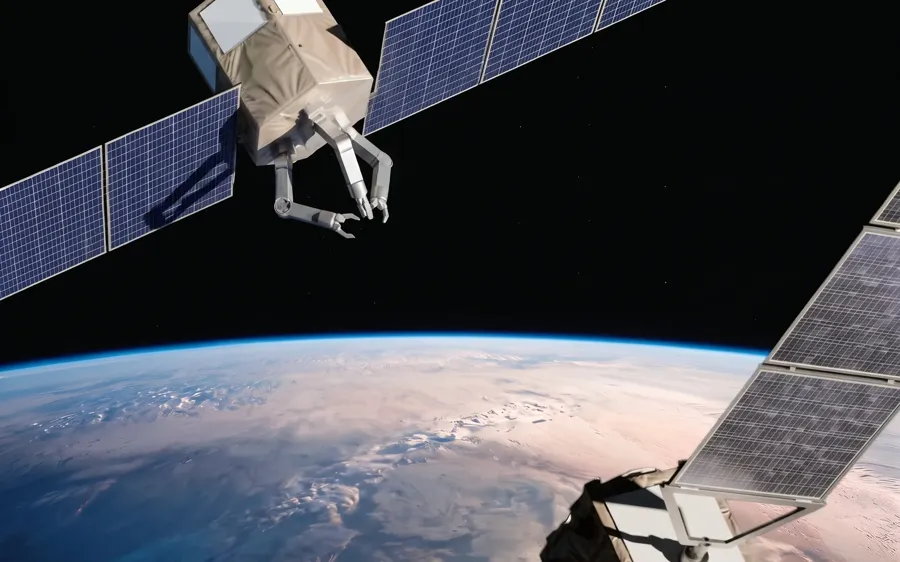
A life extension mission with Thorus follows the same sequence as its other missions. Thorus reaches the orbit of the client satellite, inspects it at close range, secures it with its robotic arms and provides station-keeping, or moves it to a new slot. When the service ends, it releases the satellite and leaves.
Moving a satellite to a graveyard orbit, or removing it from orbit, at the end of its life is a future capability for Thorus. The TAC (Tactical-Capture) and ALBATOR programmes, both coordinated by OSMOS X, prepare the technologies it needs.
What operators weigh
Extending a satellite comes down to comparing the revenue of the extra years with the cost of the service, against the alternative of a replacement satellite, which takes years to build and launch. Other factors come in: the value of the orbital slot and its frequency filing, the risk of a docking operation for a satellite that still serves customers, and insurance.
The page for satellite operators details what Thorus offers for GEO fleets. Our team can also look at a specific satellite if you send us its parameters.
Our serviceLifetime extension with ThorusStation-keeping, repositioning and recovery after launch, as a service.Frequently asked questions
How long do geostationary satellites last?
Commercial GEO satellites are commonly designed for about fifteen years. Their lifetime is often set by the propellant left for station-keeping rather than by the condition of their electronics.
What is a graveyard orbit?
An orbit a few hundred kilometres above GEO, where satellites are moved at the end of their life so that they stay clear of the operational geostationary belt. Intelsat 901 was docked with about 300 km above GEO.
Can a satellite that was not designed for servicing be docked with?
Yes. The 2020 docking with Intelsat 901 was the first with a satellite that had no docking interface. The TAC (Tactical-Capture) programme coordinated by OSMOS X develops capture without a docking interface for a wider range of objects.
Is life extension only for geostationary satellites?
The commercial missions so far have served GEO satellites, where each satellite carries a high value. The same principle applies in other orbits wherever a satellite is worth keeping in service.